
In today’s omnichannel retail landscape, decisions can no longer wait for end-of-day summaries. According to McKinsey (2024), retailers who are intensive users of customer analytics are 23 times more likely to clearly outperform peers in terms of new customer acquisition than non-intensive users. As operations expand across physical stores, e-commerce, and international markets, executives face growing complexity in consolidating data from multiple systems.
Learn more about the impact of e-commerce and physical stores on retail here.
The shift to real-time dashboards and retail reporting software is therefore not just a technical upgrade — it’s a strategic necessity. Retail leaders across Southeast Asia are turning to modern analytics platforms that provide instant visibility into performance across countries, brands, and channels.
The C-Suite Challenge: Too Much Data, Too Little Insight
Southeast Asia’s retail sector is undergoing rapid digitalisation, but many enterprise retailers still rely on manual reports and siloed data spread across POS, ERP, and CRM systems. For C-level leaders, this often means:
- Reports that arrive days or weeks late
- Inconsistent KPIs across departments
- Limited visibility into cross-border performance
- Reactive decision-making instead of proactive strategy
Executives are overwhelmed by data overload, but starved of actionable insight. This disconnect makes it harder to respond to shifting consumer behaviour, supply chain disruptions, or emerging market opportunities.
The Shift to Real-Time Dashboards and Retail Reporting Software
Retail reporting software refers to digital platforms that collect, analyse, and visualise retail performance data from multiple sources. When combined with real-time dashboards, these tools allow executives to monitor KPIs such as sales, margins, and stock levels — updated minute by minute.
Instead of static reports, leadership teams gain a single source of truth that connects data across every store, channel, and region. For example, a retailer operating across Singapore, Thailand, and Indonesia can compare same-day sales or stock turnover by region — without waiting for manual uploads or local summaries.
Business Benefits for Senior Executives
Real-time reporting provides measurable advantages for retail leadership teams. Key benefits include:
Profitability and Margin Insights
Executives can drill down into performance by store, product line, or region to identify which areas are driving or diluting profit. This enables more strategic pricing, stock allocation, and promotional planning.
Faster, Confident Decision-Making
When market conditions change — such as sudden demand shifts or supply chain delays — real-time visibility enables faster response. Decisions that once took days can now be made in minutes.
Cross-Border Performance Monitoring
For Southeast Asia’s multi-market retailers, dashboards help standardise reporting across diverse regions, currencies, and tax systems. Executives can compare KPIs from Jakarta to Bangkok with a consistent data model.
Strategic Agility
Interactive dashboards make it easier to run scenario analyses and forecast potential outcomes, supporting agile decision-making and long-term planning.
Learn more about integrating your retail systems with Retail Pro Point of Sale solutions to improve visibility and performance tracking.
Technology Enablers: Cloud, AI, and Integration
The effectiveness of modern retail reporting software lies in its technology foundations. Today’s solutions leverage:
- Cloud architecture for scalability, security, and anywhere access
- AI analytics to detect trends, predict demand, and highlight anomalies
- API integration to connect POS, ERP, CRM, and e-commerce systems
These enablers ensure data continuity and accuracy, regardless of the number of stores, brands, or countries involved. Integrated Retail helps enterprise retailers in Southeast Asia implement these connections — ensuring every decision-maker has up-to-date, trusted data.
From Data to Strategic Action: How Insights Drive Retail Growth
While cloud, AI, and integrated systems form the backbone of modern retail reporting, the real value lies in turning data into actionable strategy. Retail executives in Southeast Asia increasingly rely on analytics not just to monitor performance, but to predict trends, optimise inventory, and tailor customer experiences in real time. For example, predictive analytics can flag products likely to run out of stock in a specific city, enabling timely replenishment before lost sales occurs. Similarly, by analysing historical sales patterns alongside current market conditions, leaders can forecast demand by region or customer segment, improving both margin and customer satisfaction.
Data-driven insights also empower strategic pricing and promotional decisions. With real-time visibility into sales velocity, competitive pricing, and regional buying behaviour, executives can dynamically adjust pricing strategies, launch targeted promotions, or pivot marketing campaigns with confidence. This agility helps multi-market retailers respond faster than competitors who rely on outdated reports, ensuring a measurable advantage in both revenue growth and operational efficiency.
Moreover, integrated reporting systems facilitate cross-department collaboration. By giving merchandising, operations, marketing, and finance teams a unified view of performance, executives can break down silos and make decisions that align the organisation around common objectives. The result is faster execution, reduced inefficiencies, and a stronger connection between data insights and business outcomes.
In essence, real-time dashboards do more than display numbers — they provide a strategic lens for proactive leadership. Retailers who harness these insights can move from reactive management to predictive, evidence-based decision-making, unlocking new opportunities for growth and sustainable competitive advantage.
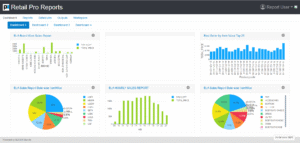
A colourful dashboard with reports of different metrics of a retail store
Introducing Krunch by Slicer: Turning Data into Decisions
Krunch by Slicer is a cloud-based reporting and analytics platform implemented and distributed by Integrated Retail. It connects multiple retail data sources into a single, dynamic reporting environment — offering executives instant insight across their entire operation.
Krunch allows leadership teams to:
- View real-time sales and inventory dashboards
- Analyse profitability by region, brand, or product category
- Monitor store performance trends over time
- Set custom alerts for KPIs such as stockouts or revenue thresholds
By consolidating data from POS, ERP, CRM, and e-commerce platforms, Krunch provides a single source of truth that empowers data-driven decision-making.
For retailers ready to move beyond spreadsheets and fragmented reporting, Integrated Retail can help implement Krunch by Slicer to achieve real-time visibility and unlock new performance insights.
Conclusion: From Data to Strategic Intelligence
In an era where speed and precision define competitive advantage, real-time dashboards have become a strategic asset for retail executives. By replacing lagging, manual reporting with unified, data-rich insights, C-suites gain the visibility needed to drive profit, efficiency, and agility.
As retail across Southeast Asia continues its digital transformation, those who leverage advanced reporting systems like Krunch by Slicer will lead with sharper foresight and faster, evidence-based decisions.
To explore how Integrated Retail can implement Krunch by Slicer for your retail organisation, book a consultation here.
Frequently Asked Questions (FAQ)
- What is retail reporting software?
Retail reporting software aggregates and visualises performance data — such as sales, stock, and margins — from multiple systems, helping executives track KPIs in one place. - How do real-time dashboards help retail executives?
They deliver up-to-the-minute insights across all stores and regions, enabling faster decision-making and improved operational control. - What systems can Krunch by Slicer integrate with?
Krunch integrates with leading retail systems including POS, ERP, CRM, and e-commerce platforms, ensuring seamless data flow across business functions. - How can I implement Krunch in my retail organisation?
Integrated Retail provides consultation, configuration, and training services to help enterprise retailers deploy Krunch by Slicer for maximum impact.