
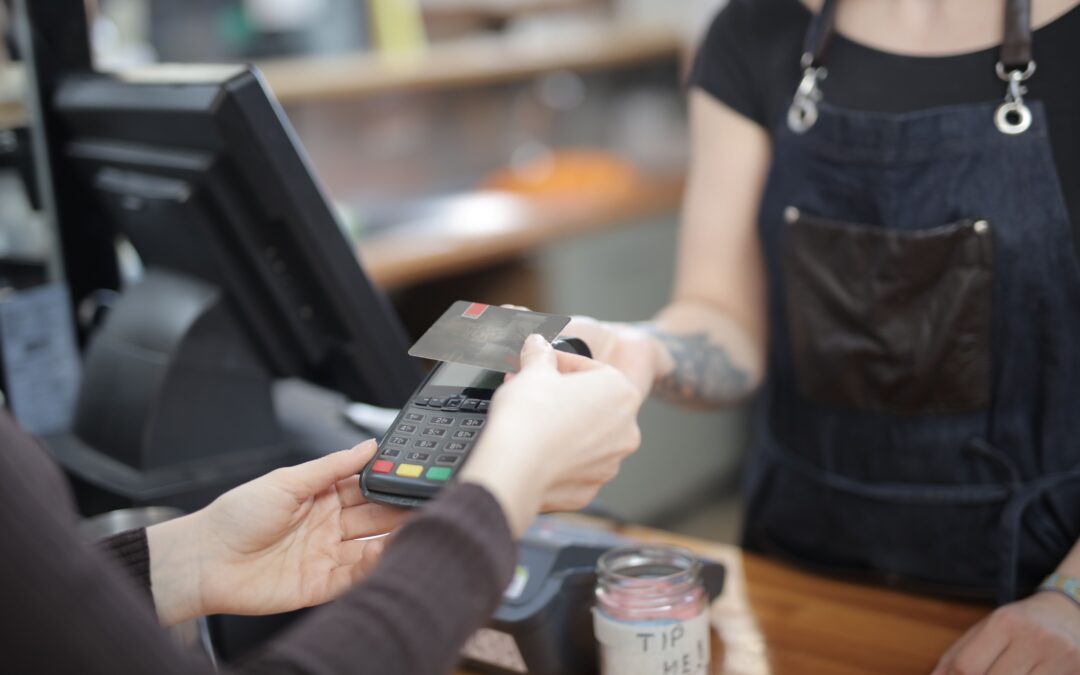
A customer is standing in your store holding the right product in the wrong size.
What happens next tells you most of what you need to know about your point-of-sale system. Either your staff member checks the network, finds the size at another branch, sells it there and then, and has it delivered — or she says “let me call around and get back to you,” and the customer leaves.
The second outcome isn’t a service failure. It’s a systems one. And it repeats quietly, several times a day, across every store you run.
What an omnichannel POS actually is
The term gets used loosely, so it’s worth being plain.
A traditional point of sale records transactions in the store it sits in. An omnichannel POS connects that store to everything else you operate — other stores, your warehouse, your e-commerce site, your marketplace and social channels — and lets any of them fulfil a sale.
In practice that means four things working together:
- One stock position. Every channel reads the same inventory, in real time, down to variant level.
- One customer record. What a staff member sees at the counter matches what the customer saw online.
- Orders that can be routed. Click and collect, reserve at another store, ship from store, and a single transaction mixing items in stock with items to order.
- Reporting across channels, so you can see which stores and which channels are actually performing.
That’s the difference between a modernised till and a platform. Plenty of systems do the first and describe themselves as the second.
Why this has stopped being optional
Three things have changed in our markets.
Customers no longer shop in one channel. The same person browses in store, buys on a phone, collects at a mall branch and asks a question on WhatsApp. They don’t experience those as separate systems, and they have no patience for a retailer who does.
Social and video commerce are no longer a side channel. Video commerce now accounts for about a quarter of e-commerce GMV across Southeast Asia, according to the 2025 e-Conomy SEA report by Google, Temasek and Bain. Very few retail systems in operation today were designed with live selling in mind, so most retailers run it as a parallel business with its own stock and its own reconciliation.
Stores are getting smaller. Prime-location rent, transit-linked sites and pop-ups all push toward compact formats. A small store physically cannot carry the range, so its value depends entirely on being able to sell from the whole network.
What it costs to not have one
The losses are real but invisible, which is why they persist.
A sale walks out because nobody could see stock in the next branch. Online shows available, the store doesn’t have it, and someone apologises. Staff at the counter can’t see a customer’s history, so the recommendation misses. Someone in the head office reconciles three systems by hand every month and the numbers still disagree.
And a quieter one: Salesforce’s Connected Shoppers Report found only 17% of store associates have access to a unified view of customer data. Most of your team is serving customers half-blind, and they’ve stopped mentioning it because nothing changes when they do.

One stock position across every store, warehouse and channel is the foundation everything else depends on.
What to look for when you evaluate
Five criteria separate serious platforms from the rest. Use them to structure demos, rather than letting a vendor structure them for you.
- Real-time unification — stock, customers and orders genuinely shared across channels, not synced overnight
- Order management — click and collect, reserve, ship from store, and returns or exchanges handled across locations
- Mobility and offline — works on the devices you want, and keeps selling when the network drops
- Multi-market capability — tax, currency and local regulatory requirements across every country you operate in
- Clienteling and analytics — purchase history available at the counter, and reporting by store, channel and category
Trading peaks are worth asking about specifically. A platform that performs well in a demo and poorly during a festive sale period is a problem you discover at the worst possible moment.
The two platforms we work with
We resell and implement both Cegid Retail and Retail Pro Prism. Both are unified commerce platforms built for specialist retail rather than general-purpose tills, and both are deployed internationally at scale.
Here’s how each publisher positions itself:
| Cegid Retail | Retail Pro Prism | |
| Describes itself as | A unified commerce platform for specialist retail | A flexible unified commerce platform for specialist retail |
| Emphasises | Native omnichannel in a shared database, clienteling, and country packages covering local tax and compliance across 75+ markets | Flexibility, an open API library for integrating third-party ERP, CRM and e-commerce, and multi-device deployment |
| Typical verticals | Fashion, luxury, beauty, cosmetics, sportswear | Fashion, footwear, jewellery, sport |
Which one suits you
In our experience the choice usually turns on three things:
How standard your processes are. If your operation looks broadly like other specialist retailers, a platform that arrives assembled gets you live faster. If you have genuinely structural differences — an unusual franchise model, a distinctive wholesale arm — flexibility matters more.
Your scale and footprint. Sixty stores across four countries is a different problem from twelve in one market, mostly because of regulatory variety rather than transaction volume.
What you’re keeping. If you have an ERP or e-commerce platform you’re not replacing, integration flexibility carries more weight than it would on a greenfield build.
We sell both, so we have no preferred answer. That’s the point — ask us what would make us recommend the other one, and expect a specific reply.
Where we come in
- Platform selection against your format, footprint and existing systems, before any demo
- Implementation of either platform across Singapore, Malaysia, Thailand and Indonesia
- Per-market configuration — tax, e-invoicing and privacy requirements documented per country
- Integration with the ERP, e-commerce and analytics you already run
- Training and first-line support, in your time zone
Not sure which fits? Tell us your store count, your markets, and the two or three requirements you think are unusual. We’ll come back with a recommendation and the reasoning behind it — including the cases where neither platform is the right answer.