
In today’s fast-moving retail environment, buzzwords like omnichannel and omnicommerce are everywhere—but many executives still use them interchangeably. The truth is: they’re not the same, and understanding the distinction is critical to building a future-ready retail operation.
Retail has come a long way from catalogue mail-ins and phone orders. With the rise of social commerce, mobile apps, smart IoT devices, and AI-driven personalisation, customers now expect more than just convenience—they demand consistency, flexibility, and instant gratification. For retailers, the question is no longer if you need a unified commerce strategy, but how to implement it effectively.
This guide clarifies the difference between omnichannel and omnicommerce, explores their respective benefits, and illustrates real-world use cases that show how both can work together to drive business results.
What Is Omnichannel in Retail?
Omnichannel retail refers to delivering a seamless, integrated shopping experience across all customer touchpoints—online, in-store, mobile, and beyond. It focuses on unifying the customer experience across all platforms while maintaining a consistent brand message and service quality.
For example, a customer might:
- Discover your product on Instagram,
- Read reviews on a marketplace,
- Purchase through your mobile app, and
- Pick up the item in-store.
With an omnichannel strategy, each of these touchpoints feels connected, consistent, and frictionless.
Key Benefits of Omnichannel Retail
- Increased Customer Loyalty
Consistency breeds trust. Customers who experience the same level of service across all channels are more likely to stay loyal to your brand. - Wider Customer Reach and Acquisition
Being available across multiple platforms (from mobile apps to physical stores) allows you to meet customers where they are. This expands your reach and boosts conversions. - Better Customer Insights
Omnichannel setups offer rich data across channels, helping retailers understand buying behaviours, channel performance, and campaign ROI. This data-driven approach enables smarter, more targeted marketing and resource allocation. - Higher Conversion Rates
Customers are more likely to complete purchases when they can switch between channels without disruption. A seamless experience from browsing to checkout reduces cart abandonment.
Omnichannel Use Case: Fashion Retailer
A regional fashion brand enables “browse online, buy in-store” by syncing its eCommerce site and mobile app with real-time in-store inventory. Shoppers can:
- Check local store availability online,
- Reserve items,
- Visit a nearby outlet to try them on,
- And use mobile POS for quick checkout.
This omnichannel strategy can increase footfall, reduce online return rates, and improve upsell opportunities during in-store visits.
What Is Omnicommerce in Retail?
Omnicommerce goes a step beyond omnichannel. While omnichannel focuses on unifying customer-facing touchpoints, omnicommerce integrates backend systems—linking inventory, logistics, payments, CRM, ERP, and analytics into one unified commerce engine.
It’s about creating a truly connected retail infrastructure where front-end and back-end systems work as one to deliver seamless operations and service.
Key Benefits of Omnicommerce
- Unified Inventory Management
Centralized inventory across all sales channels enables real-time stock visibility, smarter forecasting, and reduced risk of overstocking or stockouts. - Operational Efficiency
When your ERP, CRM, logistics, and POS systems talk to each other, you eliminate silos and reduce manual work. The result: faster fulfillment, fewer errors, and better scalability. - End-to-End Personalization
Because omnicommerce integrates back-end systems, personalisation isn’t limited to marketing messages. It extends to fulfilment preferences, payment options, and post-purchase care. - Better Decision-Making
With a unified data source, retailers can analyze performance across all touchpoints and operations—from supply chain efficiency to customer engagement—leading to smarter business decisions.
Omnicommerce Use Case: Electronics Retailer
A national electronics chain integrates its ERP, CRM, logistics, and eCommerce platforms. Here’s how it works:
- A customer purchases a laptop online.
- The system automatically assigns the nearest warehouse for fulfilment.
- Inventory is updated in real time.
- The CRM logs the transaction for future service or upselling.
Customer service teams can access full order histories, helping them resolve inquiries faster. After deploying this omnicommerce strategy, the company reduced stockouts by 35% and achieved up to 30% faster delivery times (Rapidops, n.d.; Magenest, 2023).
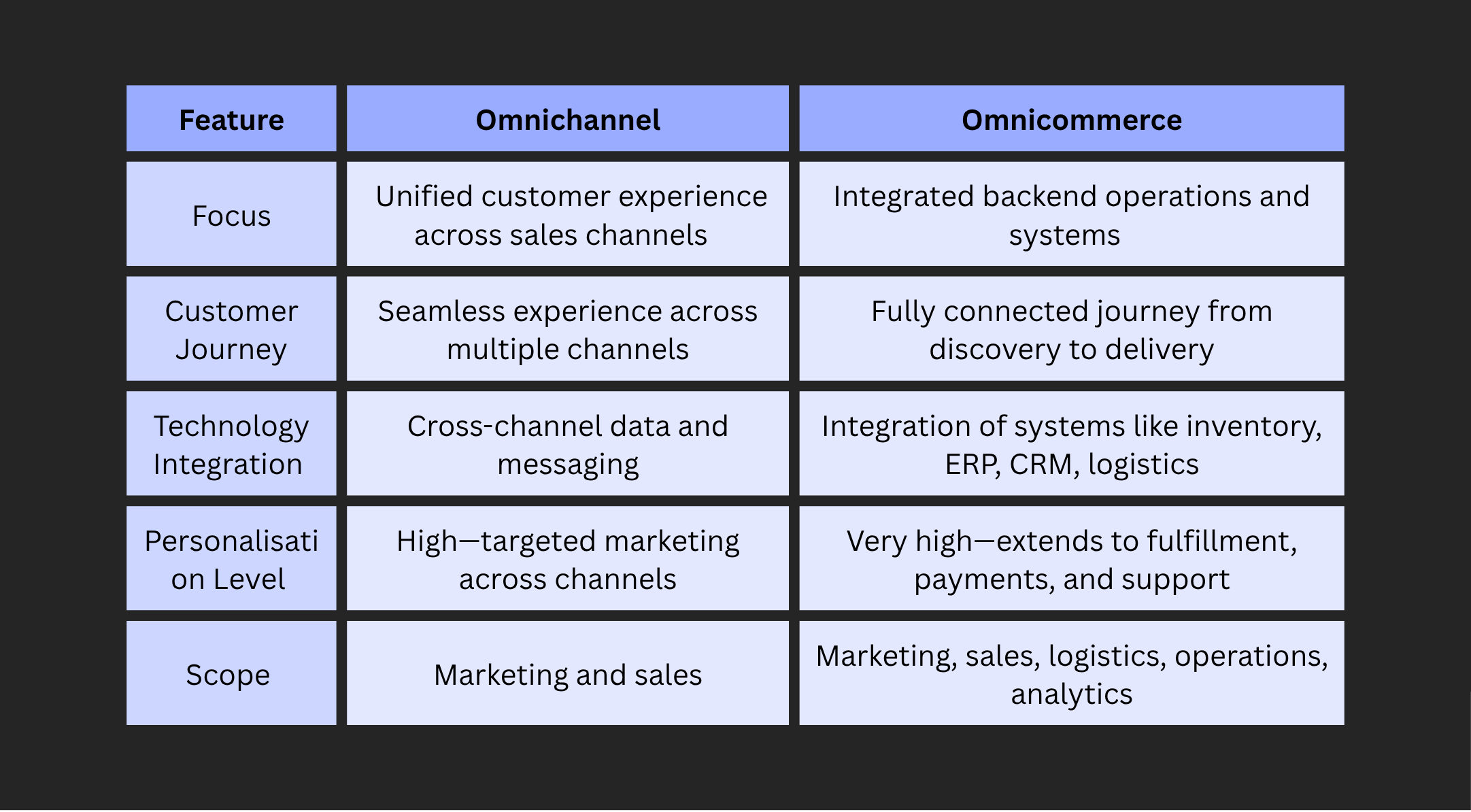
Omnichannel vs Omnicommerce: What’s the Difference?
| Feature | Omnichannel | Omnicommerce |
| Focus | Unified customer experience across sales channels | Integrated backend operations and systems |
| Customer Journey | Seamless experience across multiple channels | Fully connected journey from discovery to delivery |
| Technology Integration | Cross-channel data and messaging | Integration of systems like inventory, ERP, CRM, logistics |
| Personalisation Level | High—targeted marketing across channels | Very high—extends to fulfillment, payments, and support |
| Scope | Marketing and sales | Marketing, sales, logistics, operations, analytics |
How Omnichannel and Omnicommerce Work Together
Think of omnichannel as the front stage of your retail operation, and omnicommerce as the backstage. The customer sees a polished, seamless experience (omnichannel), but behind the scenes, your systems must be tightly integrated (omnicommerce) to make that experience possible.
Many retailers start with an omnichannel strategy—but struggle to scale when inventory, payment, and customer data remain siloed. Without the omnicommerce backbone, even the best omnichannel experience can quickly break down.
Combined Use Case: Homeware Retailer
A homeware brand offers online consultations for interior styling, in-store demos, and personalised WhatsApp follow-ups. Customers may:
- Book an appointment online,
- See product pairings during an in-store visit,
- Complete the purchase later via mobile link.
Behind the scenes, everything is powered by omnicommerce:
Inventory, order routing, CRM, and payment systems are tightly integrated—making the entire customer journey seamless. The result? Higher average order values and stronger brand engagement.
Choosing the Right Strategy for Your Retail Business
If you’re still operating with siloed systems, it’s time to rethink your retail architecture. Here’s how to begin:
- Audit your current systems: Are your POS, eCommerce, CRM, and ERP platforms connected?
- Evaluate your customer journeys: Can customers switch channels without friction?
- Align your tech stack: Use integration platforms or headless commerce to enable flexibility.
- Partner with experienced specialists: Deploying omnichannel and omnicommerce strategies requires deep retail expertise and robust implementation.
Ready to Future-Proof Your Retail Business?
Integrated Retail has helped leading retail chains implement scalable omnichannel and omnicommerce strategies that increase loyalty, drive revenue, and improve operational efficiency.
With over 20 years of domain expertise and a track record of successful implementations across Asia, our team understands what it takes to deliver retail without friction.
👉 Book a free consultation with our retail experts to explore the right omnichannel or omnicommerce solution for your business.
References
- Magenest. (2023). 25 omnichannel statistics that matter in 2023. Retrieved from https://magenest.com/en/omnichannel-retail-statistics/
- Rapidops. (n.d.). How retailers are redefining the digital shopping experience. Retrieved from https://www.rapidops.com/blog/retailers-redefining-digital-shopping-experience/