
Large-format retail analytics comes down to three questions for almost every retailer we work with: how many people are in the store, whether the checkout queue is about to break, and whether the fitting rooms are coping with demand.
Almost none of them want to replace the CCTV to get there.
That tension is where most analytics proposals fall apart. The technology works fine in a demo store. It stops being viable at store number forty, when someone adds up the cabling, the ceiling access, the after-hours installation windows and the sheer number of devices involved.
This is the architecture we deploy instead — built around what’s already on your ceiling.
The estate you actually have
Retail estates are never built to one standard. They accumulate.
A regional apparel chain typically runs analogue CCTV in stores opened a decade ago, modern IP cameras such as AXIS in the newer locations, and half a dozen layout variations between formats and markets. Ceiling heights differ. Entrance widths differ. What’s permitted around demographic data differs across Singapore, Malaysia, Thailand and Indonesia.
The operational questions, though, are remarkably consistent from store to store:
- How many visitors, and how many are in the store right now?
- Are queue conditions approaching the point where we need to open another till?
- Are the fitting rooms at capacity, and when?
- Can we see all of this consistently across the region?
The technical challenge isn’t answering any one of those questions. It’s answering all of them the same way in sixty stores that were never built the same way.
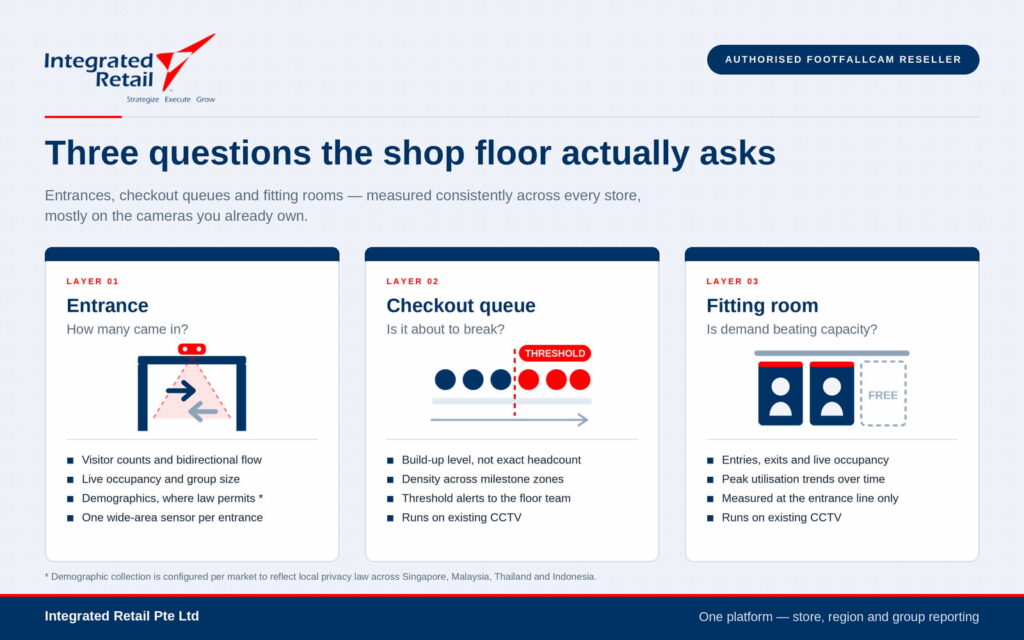
Three questions the shop floor actually asks. Most of the answers come from cameras you already own.
Three principles for large-format retail analytics
Reuse existing infrastructure where it’s genuinely fit for purpose. Cameras already positioned above queue areas and fitting room entrances are assets, not liabilities. Where the angle and image quality hold up, they can feed analytics without being replaced. Where they don’t, we’ll tell you — and we’d rather tell you during the survey than after the invoice.
Add new hardware only where precision is non-negotiable. That means entrances. Everywhere else, existing cameras do the work.
Centralise the processing. One analytics platform across the estate, not a separate system per store that someone has to log into individually.
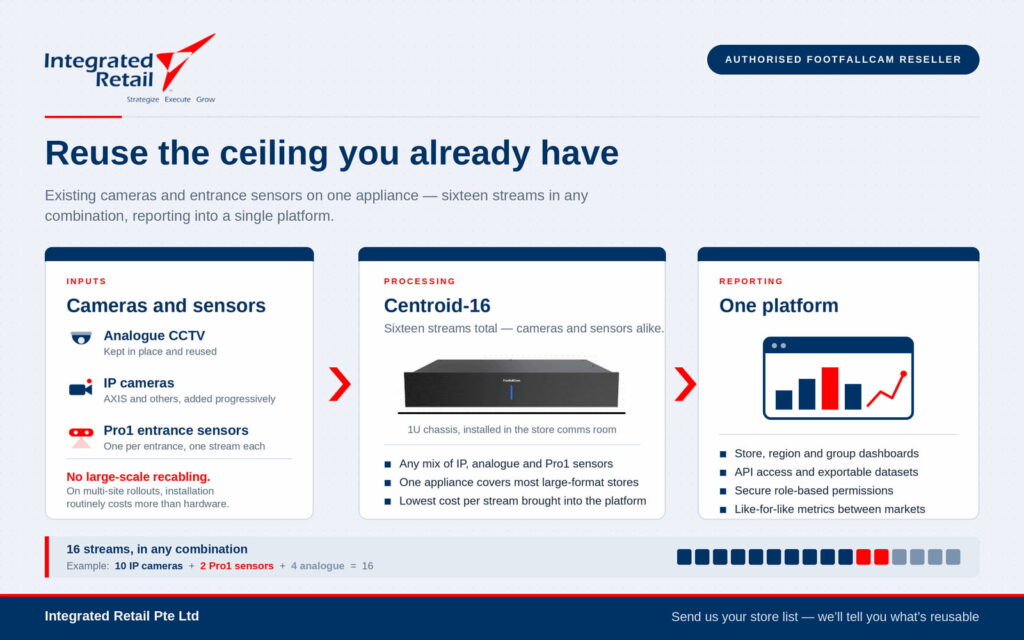
Sixteen streams in any combination — cameras and entrance sensors share the same budget.
The hidden line item: cabling, not hardware
Here’s the number that decides most large rollouts, and it’s rarely the one in the vendor comparison.
On multi-site retail deployments, installation and cabling frequently cost more than the hardware itself. Ceiling access in a trading store, after-hours labour, containment, making good — it adds up faster than the device count suggests, and it’s the part that stretches a rollout schedule from months into quarters.
This is why the processing tier matters more than the sensor tier. A single appliance that ingests your existing camera streams lets you keep the CCTV you already have as an analytics source, bring newer cameras onto the same platform progressively, and introduce analytics without large-scale recabling.
Everything shares the same channel budget on that appliance — analogue cameras, IP cameras and the entrance sensors alike. A store running ten IP cameras, two entrance sensors and four analogue cameras is one deployment of sixteen streams, not three separate systems. Nothing needs replacing in order to be counted.
The relevant number isn’t cost per device. It’s cost per camera you’ve brought into the platform, and consolidating a whole store onto one appliance is the cheapest version of that we can quote.
The estate then modernises in stages, at the pace your capex cycle allows, rather than as one disruptive replacement programme.
Entrances: sized separately, and deliberately
Entrances are the one place we don’t compromise, because every other metric is calibrated against them. They’re also the one place we use a dedicated sensor rather than an existing camera — an existing camera at a doorway is almost never mounted where accurate counting requires.
For large-format deployments that means a Pro1 above each entrance, connected into the same appliance as everything else. It takes one stream, like any camera would. One brain does the analytics for the whole store, so entrance counts and zone data arrive as a single dataset rather than two systems someone has to reconcile.
The traditional approach lines several narrow-field counters across a wide entrance and stitches the results together. It works, but it multiplies devices, mounting points and failure modes across every store in the estate. Wide-area, top-down sensing does the same job with far fewer units, delivering:
- Visitor counts and bidirectional flow
- Real-time occupancy
- Group size detection
- Demographic trends, where local privacy law permits
Where a site has unusual entrance geometry, or where a store is small enough not to warrant a store-wide deployment at all, the specification changes — we cover the entrance-only options in a separate post: Pro2 (2025) vs Pro3.
Checkout queues: thresholds, not headcounts
This is where a lot of analytics projects overreach.
Airport-style queue analytics track individuals through complex structures. Retail rarely needs that. When we ask store operations teams what they’d actually do with a precise per-lane headcount, the honest answer is usually “nothing different.”
What changes behaviour is a threshold. Is the queue short, moderate, or heading toward an unacceptable wait? That’s the trigger for opening another till or pulling someone off the floor.
So the model we deploy uses existing cameras positioned above structured queue areas to analyse customer density and progression across predefined milestone zones, and reports queue build-up against operational thresholds. Alerts go to the people who can act on them.
No additional cameras in most stores. No overengineering of a problem that resolves into three states.
Fitting rooms: the most under-measured zone in apparel
For fashion retail, the fitting room is arguably the highest-intent space in the store. A customer who enters one is deep in the purchase decision — and a customer who walks away from a queue at the fitting room entrance is a conversion you’ve already paid to acquire and then lost at the last step.
Using cameras at fitting room entrances, virtual line-crossing and occupancy estimation give you:
- Entries and exits
- Live occupancy against capacity
- Utilisation trends and peak periods
Nothing is installed inside the changing areas themselves — the measurement happens at the entrance line only. That distinction matters both for customer comfort and for how the deployment is assessed under regional privacy law.
Operationally, this is what tells you whether your fitting room staffing matches your fitting room demand, which is a question most apparel retailers currently answer by intuition.
One platform across the estate
Store-level data that lives in store-level systems doesn’t change regional decisions.
All outputs consolidate into a single platform covering individual stores, regional operations and group-wide reporting, with dashboards, API access, exportable datasets and role-based permissions. A regional manager compares like with like. A store manager sees their own numbers. Finance and IT get the access model their policies require.
Built to extend without being rebuilt
The initial deployment covers entrances, queues and fitting rooms. The architecture is designed so the next capabilities don’t require replacing what you’ve just installed:
- Zone flow analytics — customer movement between departments, using BLE-assisted flow analysis
- Product engagement analytics — Vision Language Models assessing interaction with products and displays
- Behavioural intelligence — unusual movement or dwell patterns flagged for operational attention
Because these run on the same centralised platform and shared data layer, they’re introduced as business requirements evolve rather than as a new project each time.
What this delivers commercially
- A smaller hardware footprint per store
- Materially lower installation and recabling cost
- Consistent metrics across formats and markets
- Faster rollout — fewer devices means shorter install windows
- Insight tied to decisions store teams actually make
- Infrastructure that extends rather than expires
Where we come in
Architecture is the easy part to write about. Delivery across a regional estate is where projects succeed or stall, and that’s the part we own:
- Camera suitability audit. Before anything is quoted, we assess which of your existing cameras can realistically carry analytics — mounting position and angle, field of view, resolution, lighting consistency, compression, and whether the mounting is stable enough for reliable line-crossing. Some cameras will pass. Some won’t. You get a per-store list either way.
- Site surveys across formats. Ceiling heights, entrance widths and layout variants documented per store, so the sensor plan reflects your estate rather than a reference design.
- Stream counting before hardware counting. We total the cameras worth analysing in each store first, then specify the appliance — so you aren’t paying for channels nobody will ever connect.
- Phased rollout planning. Pilot stores, then flagships, then the tail — sequenced around trading hours and your capex cycle.
- POS and business-system integration. Traffic, queue and fitting room data become useful when they sit alongside transactions.
- Regional privacy compliance. Demographic and occupancy analytics are treated differently under Singapore’s PDPA, Malaysia’s PDPA, Thailand’s PDPA and Indonesia’s PDP Law. We configure what’s collected on a per-market basis and document it, rather than deploying one configuration everywhere and hoping.
- First-line support across four markets. You contract with us. One point of contact, one escalation path, in your time zone.
Running a multi-format estate and wondering what’s actually reusable? Send us your store list and a sample of your existing camera positions. We’ll come back with a suitability assessment, a sensor plan, and a phased rollout costing — including which stores need nothing new at all.
Adapted with permission from FootfallCam’s original article. Full version: Read here