
Personalisation Is Now a Profit Lever
Personalisation has moved beyond marketing optimisation — it is now a measurable driver of enterprise growth.
McKinsey’s research shows that companies that excel at personalisation generate 40% more revenue from those activities than average performers. This is not incremental improvement. It signals that when customer data is operationalised effectively, it materially shifts revenue performance.
At the same time, customer expectations are accelerating. According to Salesforce’s State of the Connected Customer, 73% of customers expect companies to understand their unique needs and expectations . In other words, relevance is no longer a competitive differentiator — it is the baseline.
The convergence of these two realities creates a strategic inflection point. Customers demand individualised experiences, and the financial upside of delivering them is substantial. For retail leaders in Singapore, Thailand, and Indonesia, this reframes hyper-personalisation in retail from a marketing initiative into a board-level growth lever.
In markets characterised by digital acceleration, omnichannel behaviour, and compressed margins, the winners will be those who treat first-party data as a strategic asset — and apply AI-driven personalisation to convert that asset into revenue, margin resilience, and long-term customer lifetime value.
The question is no longer whether personalisation matters. The question is whether it is being executed at a level that meaningfully impacts growth.
The Personalisation Imperative in Southeast Asia
Southeast Asia is one of the world’s fastest-evolving retail markets.
Digital adoption is high. Mobile commerce dominates. Cross-border shopping is common. Consumers effortlessly move between physical stores, marketplaces, brand websites, and social commerce channels.
→ Read more about whether brick-and-mortar or ecommerce is leading the retail race here.
In Singapore, customers expect seamless omnichannel experiences.
In Thailand and Indonesia, mobile-first engagement is shaping purchase journeys.
Marketplace competition continues to compress margins. Loyalty is increasingly transactional. Promotions alone are no longer sufficient to retain customers.
This is why hyper-personalisation in retail has become a strategic growth lever. It enables:
- Revenue growth without relying solely on store expansion
- Margin improvement through smarter targeting
- Customer lifetime value expansion
- Stronger differentiation in crowded marketplaces
For executive teams focused on sustainable retail revenue growth, the competitive advantage lies in data-driven retail strategies — not just physical footprint.

What Hyper-Personalisation Means in Business Terms
Traditional personalisation often meant segmenting customers into broad categories: “VIP,” “new customer,” or “discount shopper.”
Hyper-personalisation goes far beyond that.
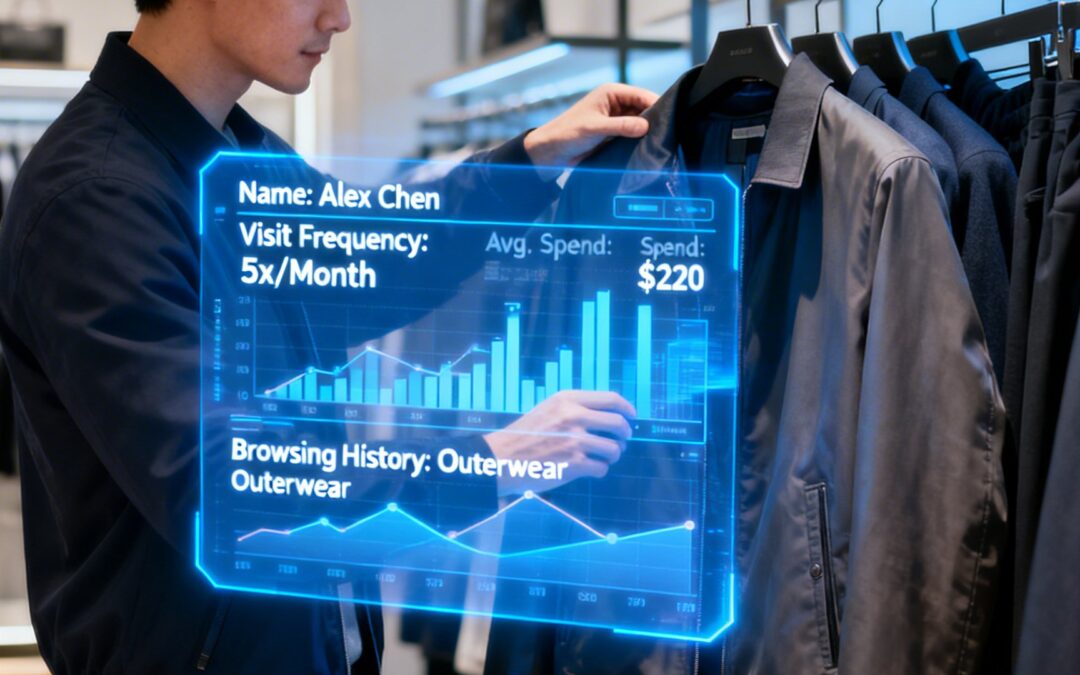
It uses real-time retail customer data — behavioural signals, purchase history, browsing patterns, location context — to deliver highly relevant offers, recommendations, and engagement at the individual level.
In business terms, hyper-personalisation enables:
- Real-time product recommendations
- Contextual promotions based on behaviour
- Location-aware engagement
- Dynamic pricing or bundling strategies
- Automated loyalty rewards tailored to individual value
AI-driven personalisation moves beyond static rules. It applies predictive models to determine:
- What a customer is likely to buy next
- When they are most receptive to engagement
- What incentive maximises conversion without eroding margin
This is not about adding complexity. It is about increasing precision.
Why First-Party Data Is the Strategic Asset
At the core of hyper-personalisation in retail lies first-party data retail strategy.
The Shift Away from Third-Party Data
The decline of third-party cookies and tighter privacy regulations globally — including Singapore’s PDPA and Indonesia’s data protection laws — are reshaping digital engagement.
Retailers can no longer depend on rented data ecosystems.
Owning the customer relationship — and the data that comes with it — is now essential.
Defining the Key Terms
First-party data
Data collected directly from customers through owned channels: POS transactions, website activity, loyalty programs, mobile apps, customer service interactions.
Zero-party data
Data customers intentionally share: preferences, style choices, feedback, wish lists.
Customer Data Platform (CDP)
A system that centralises and unifies retail customer data from multiple sources, creating a single, actionable customer profile.
A well-structured customer data platform retail strategy enables omnichannel personalisation. It connects in-store behaviour with digital activity, allowing AI in retail Southeast Asia to function effectively.
From a valuation perspective, first-party data is not just operational data — it is an asset. It strengthens customer lifetime value projections, reduces acquisition costs, and increases resilience against platform dependency.
The Business Case: Revenue, Margin, and Operational Efficiency
Hyper-personalisation powered by retail AI solutions drives measurable financial outcomes.
Revenue Growth
- Increased basket size through intelligent cross-selling
- Higher conversion rates via targeted offers
- Reduced churn through predictive engagement
Margin Improvement
- Promotion optimisation reduces blanket discounting
- Smarter segmentation preserves pricing integrity
- Dynamic bundling increases perceived value without eroding gross margin
Operational Efficiency
- Predictive demand signals improve inventory planning
- Better campaign targeting enhances ROI
- Automated engagement reduces manual workload
For retailers expanding across Southeast Asia, AI-driven personalisation also enables scalable localisation — adapting offers by market without fragmenting strategy.
Hyper-personalisation is not a marketing tactic. It is a profitability engine.
The AI Layer: Turning Retail Customer Data into Action
Raw data alone does not generate growth.
Without intelligence, data remains fragmented across systems — POS, ecommerce, CRM, loyalty platforms.
Retail AI solutions provide the orchestration layer that transforms data into action:
- Predictive segmentation
- Automated campaign triggers
- Real-time offer optimisation
- Customer churn prediction
- Dynamic product recommendations
AI-driven personalisation ensures that engagement decisions are made instantly — at checkout, during browsing, or via mobile notification.
This is where many retail digital transformation initiatives fall short. Systems are implemented, but data remains siloed. Activation becomes manual. Personalisation remains superficial.
True transformation occurs when AI sits on top of integrated infrastructure — including modern Point of Sale systems, ecommerce platforms, and loyalty ecosystems — creating unified intelligence across channels.
Capturing First-Party Data Effectively Across Touchpoints
A successful first-party data strategy begins with structured capture across every customer interaction.
Key sources include:
- Integrated POS systems capturing transaction history
- Loyalty programs tied to omnichannel profiles
- Digital receipts linking offline and online journeys
- Mobile-first engagement channels
- Conversational AI interfaces
- In-store clienteling tools
Conversational AI is emerging as a powerful enabler of zero-party and first-party data collection. By engaging customers in natural dialogue — whether via messaging platforms or websites — retailers can capture intent, preferences, and contextual signals in real time.
Integrated Retail’s Allegory AI is designed to bridge engagement and data capture.
As a conversational AI solution built for retail environments and powered by advanced AI capabilities , it enables retailers to:
- Engage customers across digital and in-store touchpoints
- Capture structured first-party and zero-party data
- Feed unified profiles into customer data platforms
- Activate AI-driven personalisation at scale
The result is not simply better engagement — but a continuously improving data asset that fuels long-term retail revenue growth.
A Strategic Perspective for Retail Leaders
In Southeast Asia’s competitive landscape, expansion through new stores alone will not secure sustained advantage.
The next phase of growth will be defined by:
- Precision over promotion
- Intelligence over intuition
- Data ownership over dependency
- Customer lifetime value over one-time transactions
Retailers who invest in hyper-personalisation in retail — supported by a disciplined first-party data strategy and AI-enabled execution — position themselves for scalable, defensible growth.
For retail leaders evaluating their next phase of retail digital transformation, the question is no longer whether to adopt AI-driven personalisation — but how to build the right foundation.
Integrated Retail works with retailers across Singapore, Thailand, and Indonesia to design integrated infrastructures — spanning Point of Sale systems, data platforms, and AI-driven engagement solutions such as Allegory AI — that transform customer data into measurable growth outcomes.
For retailers in Southeast Asia looking to turn customer data into a sustainable growth engine, the next competitive edge may not be more stores — but smarter personalisation.
FAQ: Hyper-Personalisation & First-Party Data
1. What is hyper-personalisation in retail?
Hyper-personalisation uses real-time behavioural and transactional data combined with AI-driven personalisation to deliver highly relevant, individualised offers and experiences across omnichannel environments.
2. Why is first-party data important for retailers?
First-party data retail strategies ensure retailers own their customer relationships, reduce reliance on third-party platforms, comply with privacy regulations, and build long-term valuation through stronger customer lifetime value.
3. How does AI improve customer personalisation?
AI enables predictive analytics, automated segmentation, and real-time decision-making — ensuring that offers and engagement are optimised for both conversion and margin.
4. What is the difference between first-party and third-party data?
First-party data is collected directly from customers through owned channels. Third-party data is aggregated from external sources and is increasingly restricted due to privacy changes.
5. How can Southeast Asian retailers collect more first-party data?
By integrating POS systems, loyalty programs, digital receipts, conversational AI, and omnichannel engagement strategies into a unified customer data platform retail architecture.
6. What role does a customer data platform play?
A CDP centralises and unifies retail customer data from multiple systems, enabling omnichannel personalisation and AI-driven decision-making at scale.